
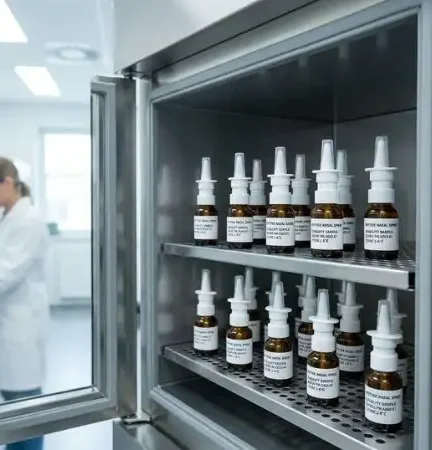
Two research peptides can be equally pure and still behave very differently on the shelf, and the reason is usually the format. A lyophilized vial, a nasal spray, and a capsule each store and degrade in their own way, and treating them identically is a fast route to compromised material. Since peptides.com carries all three product types, it is worth knowing exactly how their storage needs diverge. Here are seven differences that matter in practice.
Everything here is written for laboratory research. All products discussed are research use only and not for human or animal consumption.
1. Dry versus dissolved changes everything
The single biggest divide is whether the compound is dry or in solution. Lyophilized vials contain freeze-dried powder, and dryness is what makes them so stable, because removing water slows the reactions that break peptides down. Nasal sprays are already in solution, so they never benefit from that dry-state protection. Capsules are dry but in a finished oral form. This dry-versus-dissolved split underlies most of the other differences on this list, so it is the first thing to register about any format.
2. Cold chain requirements are not equal
Lyophilized peptide vials generally want cold storage, often a freezer, for anything beyond short-term holding, because cold slows degradation and preserves the long shelf life that makes vials attractive. Nasal sprays follow their own product-specific storage instructions, which govern how cold they need to be kept and for how long. Capsules are typically the least demanding on temperature, needing protection from heat rather than a strict cold chain in most cases. Before you commit to a format, make sure your storage setup can actually meet its cold-chain needs.
3. Moisture is a shared enemy with different stakes
Moisture threatens every format, but the stakes vary. For a lyophilized vial, moisture is the whole thing you are guarding against, which is why you let a cold vial warm to room temperature before opening, so condensation does not form on the glass and reintroduce water into the powder. For capsules, moisture can affect both the shell and the compound, so keeping them dry is essential. For a nasal spray already in solution, the moisture concern shifts to contamination and the integrity of the formulation rather than keeping water out. Same enemy, different battleground.
4. Freeze-thaw is a vial problem specifically
Repeated freezing and thawing degrades peptides, and this is largely a concern for reconstituted vials. Once you dissolve a vial and freeze the solution, every thaw-and-refreeze cycle chips away at the compound. The fix is aliquoting, dividing the reconstituted solution into single-use portions before freezing so each one is thawed only once. Nasal sprays and capsules are not subjected to this cycle in the same way, since they are used as supplied rather than repeatedly frozen and thawed. If you work mostly with vials, mastering aliquoting is the highest-value storage habit you can build.
5. Shelf life before use differs sharply

How long a product lasts before you even open it depends heavily on format. Lyophilized vials, kept dry and frozen, can remain stable for long stretches, which is part of why so much of the peptides.com catalog uses them. A nasal spray in solution has a shorter, product-specific shelf life because it lacks the dry-state advantage. Capsules generally store well over time when kept dry and cool. If you need to hold a compound for an extended period before use, the lyophilized vial’s shelf life is a real advantage worth factoring in.
6. Stability after opening flips the picture
The moment of opening or reconstitution resets the clock, and here the rankings shift. A lyophilized vial goes from very stable to fragile the instant it is reconstituted, and the solution should be treated as short-lived and kept cold. A nasal spray, once in use, has a defined usable window governed by its formulation. A capsule changes least at the point of use because there is no reconstitution and no solution to destabilize. So a format that stores brilliantly before use, like the vial, can be the most demanding after use. Plan for the stage where each format is weakest.
7. Light exposure matters more for some compounds
Light can degrade certain peptides, and how exposed a compound is depends partly on format and packaging. Vials stored in a dark freezer are naturally shielded, and amber or opaque containers add protection. Nasal sprays and capsules should likewise be kept away from strong light per their storage guidance. The practical rule is simple across all formats: store peptides in the dark unless told otherwise, since it costs nothing and removes a real risk for light-sensitive compounds.
Bringing the seven together
The through-line is that format determines the storage strategy, not the other way around. Lyophilized vials trade demanding cold storage and freeze-thaw discipline for outstanding dry-state shelf life. Nasal sprays trade long storage for ready-to-use convenience within a defined window. Capsules offer the simplest storage of the three, with moisture as the main watch-out. Whatever the format, starting with well-documented, high-purity material from a source like peptides.com gives you a clean baseline, and disciplined storage is how you protect that baseline through your research. Handle each format on its own terms and the compound will still be doing what its certificate of analysis promised when you need it.
Frequently asked questions (FAQ)
Yes. Lyophilized vials generally need cold storage and careful moisture and freeze-thaw management, nasal sprays follow product-specific liquid storage rules with a defined usable window, and capsules mainly need protection from heat and moisture. The format determines the strategy.
Because freeze-thaw damage happens to reconstituted solutions that are repeatedly frozen and thawed. Vials become solutions after reconstitution, so aliquoting into single-use portions prevents repeated cycles. Nasal sprays and capsules are used as supplied and are not subjected to the same cycling.
Lyophilized vials typically have the longest pre-use shelf life when kept dry and frozen, because the dry state slows degradation. Nasal sprays in solution have shorter, product-specific shelf lives, and capsules generally store well when kept dry and cool.
This article is for educational purposes and describes storage and stability of research peptide formats. All products referenced are for research use only and are not intended for human or animal consumption or to diagnose, treat, cure, or prevent any disease.